Safety
What an agent can read, write and reach
From v0.14.0, an agent Lingtai launches can run inside one sandbox boundary, and v0.13.0 has none of what this page describes. The sandbox is srt with a policy Lingtai writes (ADR 0127). A new project is sandboxed by default; an existing one is off until its recipe has a sandbox: block.
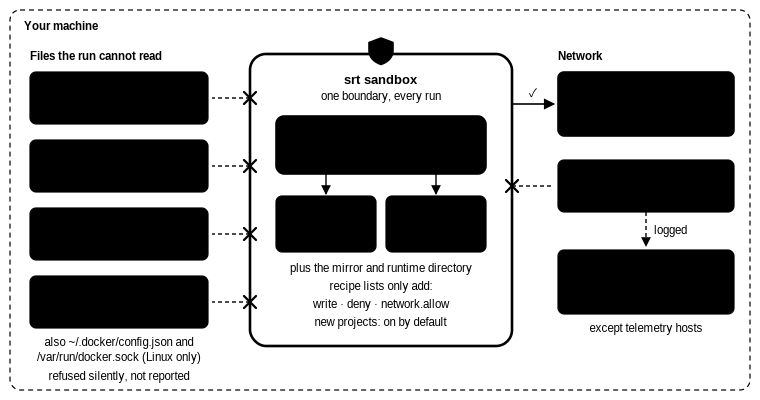
Open the diagram at full size.
What the sandbox refuses and allows#
Reads are everything except ~/.ssh, ~/.aws, ~/.config/gh, ~/.gnupg, ~/.netrc, ~/.docker/config.json, ~/.kube, ~/.npmrc, ~/.claude/.credentials.json, the whole of ~/.lingtai, and the project's own deny. So are macOS ~/Library/Keychains and Linux /var/run/docker.sock. The run's worktree, the repository mirror (~/.lingtai/repos/<project>.git) and cache are allowed back inside ~/.lingtai; the mirror holds every commit and ref, not only the checkout.
Writes are an allowlist: the worktree, the mirror, the temp directories, the project's cache and its write. Each runtime adds one directory: Claude Code its own configuration directory, and Codex all of ~/.codex except config.toml, AGENTS.md and rules, so a Codex run can change ~/.codex/auth.json without any write in the recipe.
Network is the built-in hosts (Anthropic, OpenAI, claude.ai, npm, GitHub) plus the project's network.allow, and nothing else. A Copilot run, and no other, also reaches *.githubcopilot.com and writes ~/.copilot. A refused connection shows on the task page's Sandbox tab, and if the run then fails the step stops for you with no fix round (a run that succeeds anyway goes on); telemetry hosts such as sentry.io are refused and not shown.
Unix sockets. On Linux every one is reachable; on macOS only the hook-socket directory.
Wrapped: Claude Code, Codex, every run: command and the base check. Not wrapped: a subscriber, and the merge lane's own git, which pushes and merges.
Turning it on#
Setup asks and writes the answer for a new project; it never writes required or touches an existing recipe. By hand, add the block to ~/.lingtai/<project>/recipe.yml:
sandbox:
  enabled: true # default true inside a present block; false is the explicit off
  required: true # default false; true refuses the project on a host that cannot sandbox
  network:
    allow: [pypi.org, files.pythonhosted.org] # added to the built-in hosts, never removing one
  write: [~/work/fixtures] # added to the writable paths
  deny: [~/secrets] # added to the unreadable paths
Entries only add, paths are ~/… or absolute, and a protected path is refused; the reference has every rule. A sandboxed Claude Code or Copilot run cannot use your login; the token it holds instead is made once: requirements. lingtai doctor checks the host (also there).
What the sandbox does not cover#
Do not read the sandbox as more than this:
- The run's own token is readable inside it. A sandboxed Claude Code run holds a long-lived token. It can reach only allowlisted hosts, and revoking it is yours to do.
- Codex's login is readable to a Codex run (
~/.codex/auth.json). - The Copilot token is readable to a Copilot run, which reaches only
*.githubcopilot.combeyond the allowlist. Revoking it is yours to do. - A refused file read is not reported.
srtreports a refused connection and does not report a refused file access, so the run sees an error and you see nothing. srtis a research preview, pinned to one version and recorded on every run. The pin is raised only after the canary passes on both platforms.- On macOS a run can read other processes' command lines, and so for a moment another run's network id, which gives that project's allowlist and nothing more.
- On Linux every Unix socket is reachable, except the ones read-denied by name, such as
/var/run/docker.sock.
gh is closed to a sandboxed agent: ~/.config/gh is denied, so it cannot act as you on GitHub. Lingtai pushes and merges itself, outside the sandbox.
When the host cannot sandbox#
required: false(the default): runs go ahead unsandboxed, and each is marked. The project is degraded;lingtai doctorsays so.required: true: the project is refused when its recipe resolves, and stopped until the host can sandbox. If a host loses the sandbox in the middle of an attempt, the attempt fails with no fix round.
Antigravity cannot run sandboxed on any host in this release: it runs unsandboxed, and required: true refuses a recipe that names it.
Unsandboxed, the agent reads any file you can, including ~/.lingtai/config.yml and ~/.ssh. What a runtime's own settings can narrow is in the operating guide. At every tier the agent works in its own worktree, its environment is filtered to a few variables and those your project declares, and the recipe that sets its gates lives outside the worktree. With the sandbox off it can read the file Lingtai's credentials are kept in, where its runtime lets it.
Reference: requirements, CLI, operating, SECURITY.md.
Next#
Rendered from doc/safety.md at build time. The file is the document; this page is a projection of it, and never a copy — which is why the fix for anything wrong on it is a pull request against that file.